Tuesday, 8 November 2016

Judith Butler

Judith Butler is an American philosopher and gender theorist. She suggests that gender is not the result of nature but is socially constructed, meaning that male and female behaviour and roles are not the result of biology but are constructed and reinforced through media and culture.

A summary of Butler's points:
- Your identity is not fixed
- Your identity is more than just the social and cultural things you have expressed or have been said about you
- There is not really an 'inner self'
- Gender is a performance (though not consciously chosen) which is reinforced via repetition
- The binary divide between masculine and feminine is a social construct between male and female gender

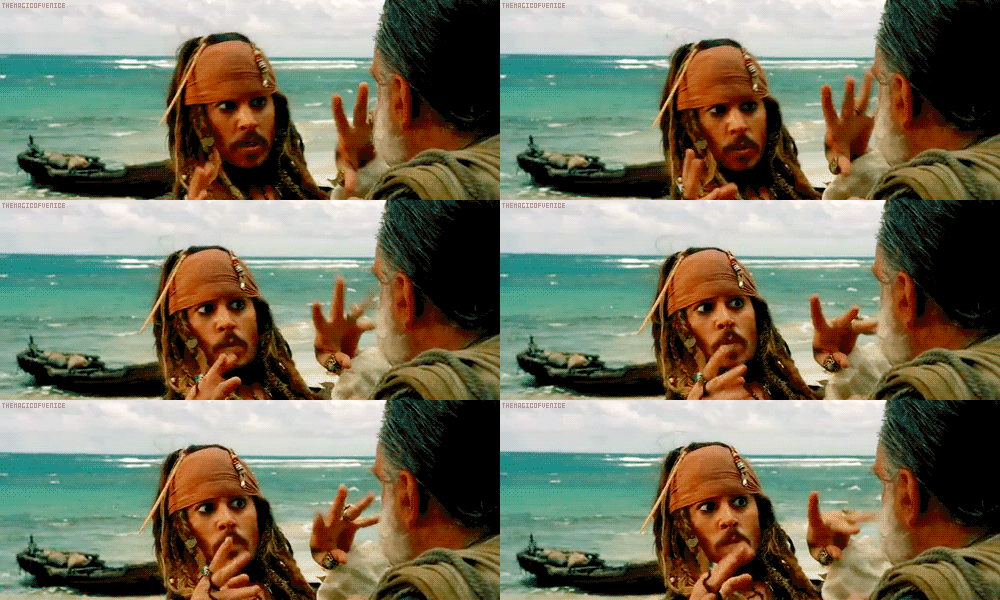
An example of the fluidity of gender/sexuality can be seen in the character of Captain Jack Sparrow in Pirates of the Caribbean. In this film the character is portrayed as iconic and over-the-top as a pirate, wearing an over-elaborate costume and eye make-up as well as using feminine and camp gestures.


Thursday, 3 November 2016

Claude Levi-Strauss Theory

Claude Levi-Strauss was a social anthropologist who studied the myths of tribal cultures. He examined how stories unconsciously reflect the values, beliefs and myths of a culture which are usually expressed in the form of binary oppositions. Strauss' research has been adapted by media theorists to reveal underlying themes and symbolic oppositions in media texts.

Roland Barthe's Theory

Roland Barthes was a French literary theorist, philosopher, critic and semiotician (study of cultural signs and symbols). Barthes described text as a tangled ball of threads that needs to be unravelled so that the audience/reader is exposed to the many meanings throughout the text, unravelling the narrative so that they encounter different angles of meaning. He suggested that there are one or more of the five codes that describe the meaning of a text, stating that texts may be 'open' meaning that they can be used in lots of different ways or 'closed' meaning that there is only one obvious thread.

Enigma code
Also known as the Hermeneutic code, the Enigma code refers to a mystery within the text. Clues are given throughout the narrative but no clear answers are provided. The enigmas within the narrative make the audience want to know more and enigmas frustrate the audience when left unsolved or unanswered.

Action code
Also known as the Proairetic code, the Action Code contains elements of action in the text and the proairetic elements add suspense to the narrative. This leaves the audience guessing at what may happen next.

Semantic code
The Semantic code refers to parts within the narrative that suggest or refer to additional meanings and interpretations. Elements of the semantic code are called Semes and have a connotative function in the narrative, meaning that it has additional meaning.

Symbolic code
The Symbolic code is about the symbolism found within the text. It uses opposites to show contrast and create greater meaning, creating tension, drama and character development.

Referential code
Finally, the Referential code refers to anything in the text which refers to an external part of knowledge such as scientific, historical and cultural knowledge.

Wednesday, 2 November 2016

Tzvetan Todorov's Theory

Tzvetan Todorov's is a Bulgarian literary theorist and philosopher who suggests that stories begin with a state of equilibrium in which the protagonist's life is normal, where any potentially opposing forces are in balance. This is disrupted by an event, setting in chain a series of events until the problems are solved so that order can be restored to the fictional world.

Todorov stated that there are five structured stages:
- a state of equilibrium at the start
- a disruption of the equilibrium
- a recognition that there has been a disruption
- a reinstatement of the equilibrium

Todorov's theory can be applied to many 'mainstream' film narratives such as Lord of the Rings. A state of equilibrium is shown at the start when the hobbits prepare for Bilbo's eleventy-first birthday, throwing a party in celebration. The disruption is caused by Bilbo giving Frodo his ring which happens to be the One Ring forged by Lord Sauron. When Frodo is hunted by the Nazgûl and stabbed by a morgul blade before being rescued and taken to Imladris (Rivendell) in order to heal. This restores an element of equilibrium for a time before the Council of Elrond addresses the true disruption of the film: that the One Ring must be destroyed in order to defeat Sauron. Only once the ring is truly destroyed in Mount Doom is the sense of equilibrium restored.

Vladimir Propp Theory

Vladimir Propp was a literary critic who created the idea of a certain type of character found in narrative structures in films. He analysed over 100 Russian fairytales in the 1920s and proposed that it was possible to classify the characters and their actions into clearly defined roles and functions, following a specific narrative structure. Specifically, Propp suggested that there are eight character types: the Villain, the Dispatcher, the Helper, the Princess, the Father, the Donor, the Hero and the False Hero. I have studied these and referred to examples in each of these characters from fantasy television series 'The Shannara Chronicles'.

The Villain
The Villain fights the hero in some way. The Villain and the Hero are normally juxtaposed by their appearance as the Villain will be portrayed as unattractive, sinister and creepy. This is normally achieved by having the character bear scars or unflattering features whilst their costume is normally dark and mysterious.

The character of the Villain can be seen in 'The Shannara Chronicles' as the Dagda Mor. This is down to his evil deeds in attempting to turn the world back into a realm of darkness and demons. He also stereotypically fits the description as being gnarled and scarred which can be seen due to the piercings and scars running down his face.
The Dispatcher
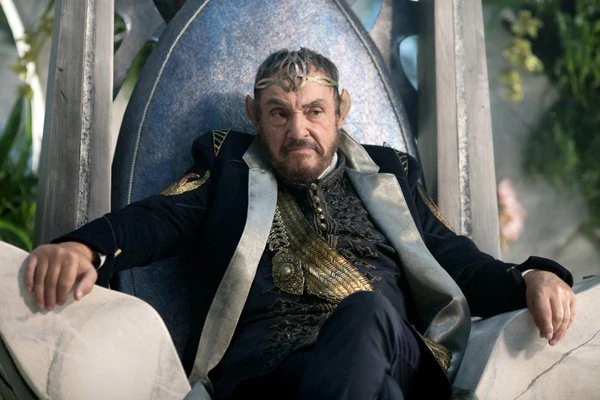
The Dispatcher is a character who makes the Villain's evil deeds known so that they can send the Hero on their journey, encouraging the Hero to eliminate evil.

The character of the Dispatcher in 'The Shannara Chronicles' is the character of the Elven King, Eventine. King Eventine first brings the idea of magic and demons back to the realm of the elves after having made them believe that magic was a lie. With the aid of Allanon, King Eventine sends his granddaughter, Amberle on her quest to save the Elcrys tree.

The Helper
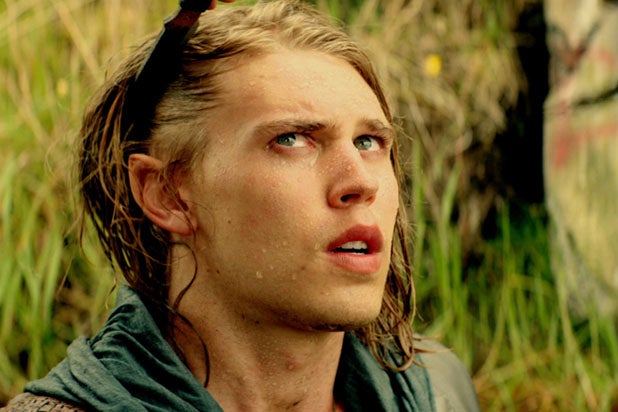
Unsurprisingly, the Helper helps the Hero on their quest.

The character of the Helper in 'The Shanara Chronicles' is the character of Eretria. Although she is at first presented as an enemy to both Wil and Amberle, Eretria ultimately ends up helping them both on the quest in unlocking the Blood-Fire with her own blood and the tattoo on her back.
The Princess
The Princess provides the role of a character that the Hero wants but is unable to marry due to an unfair evil, normally caused by the Villain. The Hero's journey/quest normally ends when the Hero is finally allowed to marry the Princess after having beaten the Villain.

Although a male character, in 'The Shannara Chronicles' I think the character of Wil fits into the role of the Princess. Wil is the love interest of both Amberle (Hero) and Eritrea (Helper) and is ultimately what Amberle wants even though he is only a half-elf. He also fits under this category as he and Amberle almost get together before the end of the season when she becomes the Elcrys - therefore preventing them from being together.

The Father
The Father normally gives the task to the hero, identifies the false hero or marries the hero. Propp found that the roles of the Father and the Princess cannot be clearly established and their roles can actually merge into one.

The character of the Father falls to Ander in 'The Shannara Chronicles' as he encourages Amberle to succeed as her uncle, having watched over her ever since his brother Aine was murdered. Ander's character also identifies as the False Hero as the demons in the Arborlorn - who eventually bring Ander's other brother, Arion back from the dead to fight for their cause instead of for the elves -leave Ander with no choice but to kill his brother.

The Donor
The Donor prepares the Hero for the quest or gives the Hero a magical object.

Allanon's character in 'The Shannara Chronicles' as one of the last druids is the Donor. Allanon prepares both Amerble and Wil for their quest to save the Elcrys and gives Wil his three elfstones  as well as telling Amberle how to retrieve the Elcrys seed.

The Hero
Normally the protagonist of the story or film, the Hero reacts to the Donor and ultimately marries the Princess.

In 'The Shannara Chronicles' Amberle is the protagonist of the series and also the leader of the quest to save the Elcrys. However, her role as a Hero is debatable because although she interacts with Allanon (the Donor) she is in fact the love interest of Wil and is kidnapped or taken away just like the role of the Princess would only for Wil to save her.


False Hero
The False Hero normally takes credit for the Hero's actions or attempts to marry the Princess.
Friday, 16 September 2016

The 'Male Gaze' Theory

The Male Gaze Theory suggests that most films are shot from a male perspective. The concept was first developed by feminist film critic Laura Mulvey. Her analysis on this shows that mainstream cinema is patriarchal in nature, arguing that in films women exist to be looked at by both the male protagonist and the spectators in the audience.

The male gaze occurs when the camera puts the audience into the perspective of a heterosexual man e.g. lingering over the curves of a woman's body. The man is presented as the dominant power in the film and the woman is passive to the active gaze from the man. This emphasises a form of patriarchal authority and also suggests that the male gaze denies women their human identity, making them objects to be admired for physical appearance and male desire. Therefore the female actor is never meant to portray a character that directly affects the outcome of the plot but is instead inserted into the film to support the male role.

This means that the woman is passive to the active gaze from the man and can be linked to scopophilia (a pleasure derived from looking). Mulvey also states that the female gaze is the same as the male gaze, meaning that women look at themselves through the eyes of men.